AI as a Strategic Business Advantage: Insights from the Critical & Emerging Technologies Index
Artificial Intelligence (AI) is no longer confined to research labs or experimental pilot programs. Today, it is a decisive factor in business strategy, shaping how companies compete, grow, and innovate. The latest Critical & Emerging Technologies Index underscores AI’s transformative impact—not just on technology, but on global market dynamics, geopolitical influence, and corporate leadership.
In this article, we explore how AI is driving competitive advantage, the global trends that matter for business, and actionable strategies for companies that want to lead rather than follow.
AI: From Efficiency Tool to Strategic Asset
Traditionally, businesses approached AI as a way to reduce costs or automate routine processes. While operational efficiency remains important, AI’s role has expanded to become a strategic differentiator. Companies integrating AI across product development, customer engagement, and decision-making are building capabilities that are difficult to replicate, giving them a durable competitive edge.
Key strategic benefits include:
Enhanced decision-making: AI-driven analytics and predictive models allow firms to anticipate market shifts, optimize operations, and improve forecasting accuracy.
Customer-centric innovation: From personalized recommendations to dynamic pricing, AI enables more responsive, tailored experiences.
Resilience and scalability: Intelligent automation and risk modeling help companies respond quickly to disruptions while scaling operations efficiently.
However, these advantages are contingent on three critical resources: talent, data, and compute infrastructure. Companies that can secure and integrate these resources will lead the AI-powered economy, while others risk falling behind.
Global AI Trends with Business Implications
The Critical & Emerging Technologies Index highlights significant regional trends, each with unique implications for businesses:
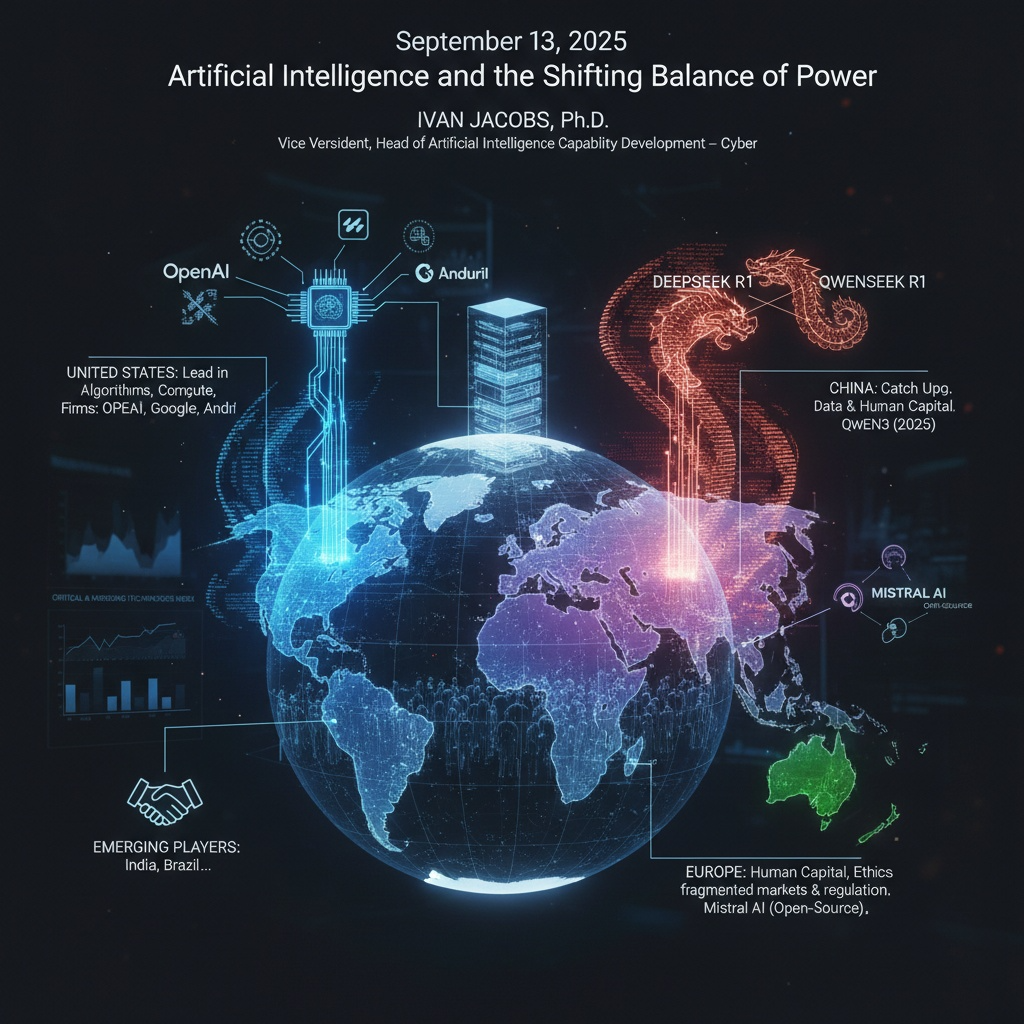
United States – Innovation-driven Ecosystem
U.S. firms dominate in frontier models, advanced algorithms, and high-performance compute infrastructure. The combination of world-class research institutions, venture capital, and entrepreneurial culture enables rapid commercialization of cutting-edge AI products. For businesses, this ecosystem accelerates access to the latest tools and talent.
China – Cost Efficiency and Scale
Chinese companies excel in lean AI architectures and low-cost training pipelines, allowing them to scale AI solutions quickly and affordably. Global businesses must recognize this rising competition and consider strategies for efficiency, pricing, and market positioning to maintain their edge.
Europe – Governance-First Approach
Europe emphasizes trustworthy AI, prioritizing compliance, ethics, and regulatory alignment. While innovation may be slower, European firms benefit from credibility in regulated markets, increasingly valued by clients worldwide who prioritize safety, accountability, and data privacy.
Emerging Markets – Untapped Potential
Countries like India, Brazil, and the UAE possess rich talent pools and data availability but lag in compute infrastructure. As cloud adoption expands and infrastructure improves, these markets could leapfrog in AI capabilities, creating opportunities for partnerships, joint ventures, and rapid scaling.
Key Business Takeaways
For companies aiming to leverage AI as a strategic advantage, the following considerations are critical:
Invest in compute access: Partnerships with cloud providers and national or sovereign compute strategies will be pivotal for scaling AI-driven products.
Prioritize talent pipelines: Attracting, training, and retaining top-tier AI researchers and engineers will be a defining competitive differentiator.
Balance compliance and innovation: Navigating divergent regulatory landscapes—especially between the EU, U.S., and China—is essential for global operations.
Monitor the cost curve: Efficiency innovations, particularly from Chinese competitors, will influence pricing strategies and product design decisions.
AI Trends and Business Implications Over the Next 3 Years
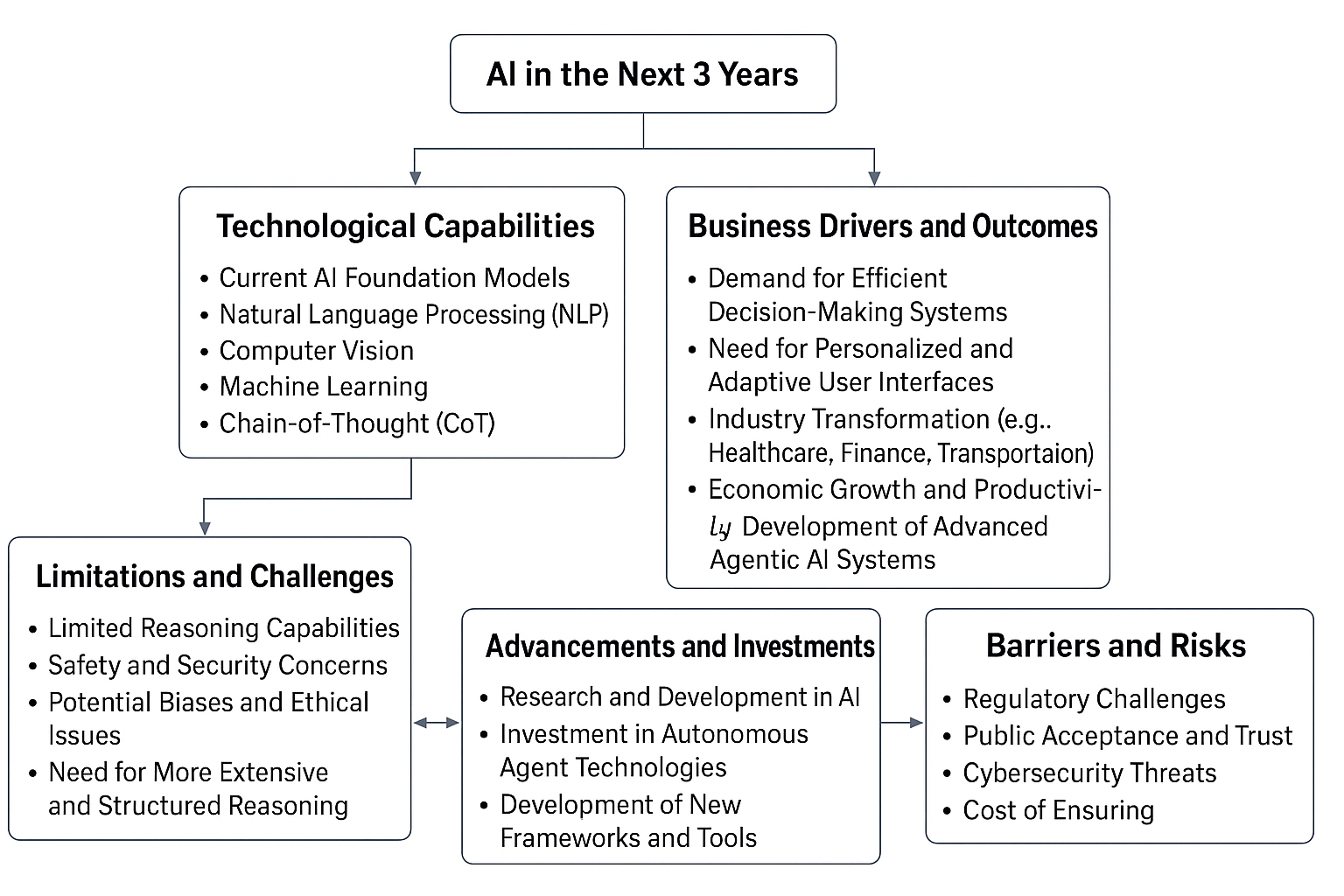
Using a causal graph framework of technological capabilities, limitations, business drivers, investments, and risks, we can anticipate AI’s evolution over the near term:
1. Technological Capabilities
AI will advance through the integration of LLMs with planning, reasoning, and verification methods. Key enablers include:
Advanced reasoning methods: Chain-of-Thought (CoT), Tree-of-Thoughts (ToT), Graph-of-Thoughts (GoT), and Self-Consistency Voting.
Autonomous decision-making: Hierarchical decomposition and planning algorithms will improve multi-step reasoning.
Human-in-the-loop alignment: Feedback mechanisms and human evaluators will enhance trustworthiness and practical problem-solving.
Business impact: These capabilities will drive improved decision quality, more efficient workflows, and personalized AI services across industries.
2. Limitations and Challenges
Despite rapid progress, AI faces inherent constraints:
Limited advanced reasoning and reflection abilities.
Biases, ethical risks, and security concerns.
Computationally intensive training and verification methods.
Business implication: Companies that manage these challenges effectively—through high-quality instruction datasets, robust verification processes, and human oversight—will gain a competitive edge.
3. Advancements and Investments
Expect substantial R&D and investment in agentic AI and integrated frameworks:
Reinforcement learning approaches (e.g., GRPO) to optimize planning and solution refinement.
Advanced LLMs capable of self-validation and evaluation of partial solutions.
Diversity-based reasoning and human preference alignment to improve decision outcomes.
Business impact: Early adopters of these innovations will develop high-performance AI systems that scale across domains, from finance to healthcare.
4. Business Drivers and Outcomes
AI adoption will be fueled by strong demand for efficiency, personalization, and transformative applications:
Intelligent decision-making systems for executive and operational workflows.
Adaptive interfaces and personalized AI services for end-users.
Industry-specific agentic AI solutions that enhance productivity, trust, and alignment with human decision-makers.
Business impact: Organizations leveraging these drivers will increase market share, boost productivity, and foster innovation-led growth.
5. Barriers and Risks
AI growth is not without risks and regulatory challenges:
Divergent regional regulations, particularly in the EU, U.S., and China.
Public trust and acceptance of autonomous AI agents.
Cybersecurity threats and operational risks in large-scale deployments.
Business implication: Companies must develop robust governance, ethical frameworks, and cybersecurity strategies to ensure sustainable adoption.
Projected Evolution (2025–2028)
Using the causal graph as a lens, we can anticipate the next three years of AI:
Technological maturation: Advanced reasoning and planning algorithms integrated with LLMs will handle increasingly complex problems autonomously.
Business adoption acceleration: Enterprises across healthcare, finance, transportation, and beyond will integrate AI as a strategic capability, not just a tool.
Investment-driven growth: Significant R&D, cloud compute expansion, and talent acquisition will reinforce AI’s competitive advantage.
Risk mitigation: Ethical, regulatory, and security frameworks will evolve alongside AI deployment, improving trust and market acceptance.
Strategic differentiation: Companies that align AI with business strategy, human oversight, and operational goals will dominate their markets.
AI as a Leadership Imperative
Looking ahead, AI will not merely support business operations—it will redefine them. From supply chains to customer experience to product design, every layer of business is being touched by AI. Companies that view AI as a strategic capability rather than a technological tool are the ones poised to shape entire industries.
The Critical & Emerging Technologies Index makes it clear: AI is no longer a technology choice—it’s a leadership decision. Companies that recognize this shift, invest accordingly, and execute thoughtfully will define the market leaders of the next decade.